 CLASHBASE.ONLINERanked
About this Town Hall 16 base
Copy this base to Clash of Clans
Tap the button below. Clash of Clans will open so you can place this layout in an available base slot.
Copy base to the gameClash of Clans must be installed on this device.Rate this layout
Share a useful, honest experience. One review is stored per visitor for this item.
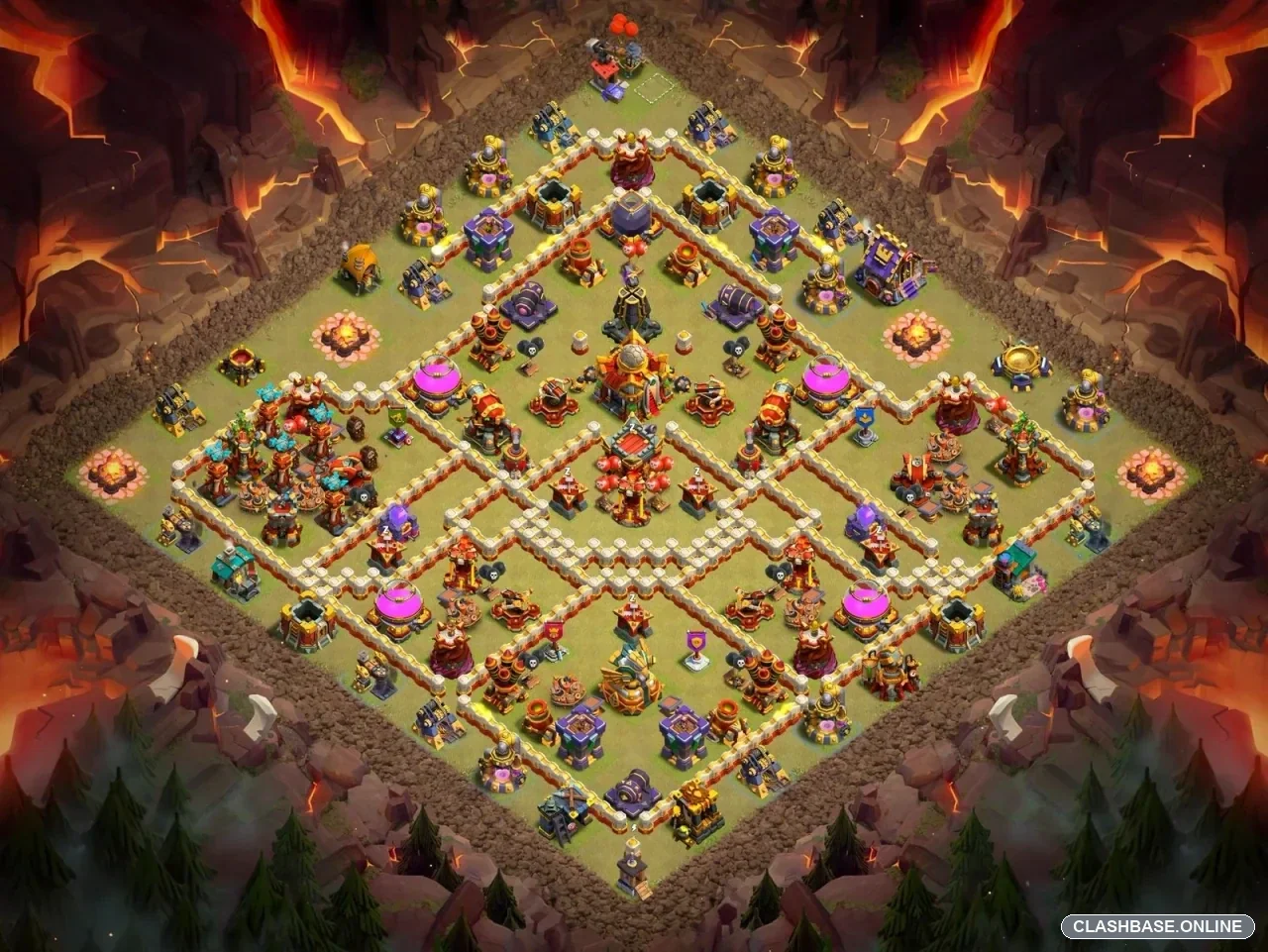
TH16 Ranked Base #5: Compact Central Core with a Right-Side Entry and High Spell Value
Town Hall 16 Ranked Layout #5 is built around a compact central core rather than an exposed Town Hall or a wide ring of loosely connected defenses. The Town Hall sits inside the primary defensive area, forcing an attacker to commit meaningful troops before the main objective becomes comfortable to reach. From the outside, the layout looks fairly symmetrical and readable. Once the first compartments begin to fall, though, several possible routes appear, and that is where troop control becomes more important than the initial entry.
The right edge, roughly around three or four o’clock, looks like the most natural place to begin shaping an attack. There is enough room to remove a few outside structures and create a funnel without spending a large part of the army. A clean entry from this side could point ground troops toward the central section while picking up useful percentage along the way.
Still, I would avoid clearing the entire right edge before deploying the main force. A very wide funnel may actually make the route less predictable. Once several buildings disappear, troops can see targets in neighboring compartments and begin moving sideways. The Queen might stay on the outside while the main tanks turn toward the Town Hall. At first, that can look like useful extra value. Both groups are destroying buildings and percentage rises quickly. The problem becomes more obvious when the central group reaches the strongest defenses without the full support army behind it.
Root Riders or another heavy ground smash composition seem well suited to testing this layout. They should have enough strength to move through the wall network, so simply breaking into the base is unlikely to be the hardest part. Keeping the attack compact may matter much more.
If Root Riders, heroes, healers, and support troops enter through one controlled lane, the attacker can use spells much more efficiently. Rage, Heal, Freeze, Overgrowth, or similar control spells can influence most of the important fight at once. When the army splits between neighboring sections, the exact same spell inventory becomes far less useful.
The central concentration creates an interesting weakness too. Several important defenses appear close enough together that a disciplined attacker may find high spell value once the core is reached. A well-timed Freeze or control spell could reduce pressure from more than one important target, while a Rage supports the main damage group in the same area.
That does not mean the core is easy. It means the attacker benefits greatly from arriving there with spells still available.
A poorly shaped entry may force early spell use just to keep the army alive or correct bad pathing. In that case, the compact middle becomes much more dangerous. A clean right-side funnel does the opposite: it preserves spells for the moment when several central defenses are active at the same time.
Queen Charge Hybrid may offer an even more controlled approach. A Queen beginning from the right side could remove one defensive pocket, eliminate a few buildings that might pull troops toward the edge, and shape a cleaner lane for Miners and Hog Riders. If the Queen follows the planned route, the Hybrid portion could move through the middle with considerably less pathing uncertainty.
The drawback is time. Queen Charges do not always follow the neat route shown during planning. One unexpected target can send the Queen farther around the perimeter, and a slow wall opening can easily add several seconds. On a Ranked layout, those seconds matter because the attack is not only about securing the Town Hall. Percentage and final cleanup remain important.
That is where this design begins to feel especially suited to Ranked play.
The attacker may be able to reach the Town Hall with a strong central push, yet buildings can remain scattered around the outer sections. Going directly for the objective saves time early but may create a longer cleanup later. Clearing more percentage before committing to the core sounds safer, although the central defenses remain active for longer.
Neither option is automatically correct.
Air attackers face another version of the same decision. The Air Defenses and Inferno Towers do not appear to form one perfectly grouped defensive block. Their spacing may force the attacker to decide which threat should be controlled first rather than simply neutralizing the entire core with one easy spell combination.
Dragons could potentially approach from the right after the funnel is established. I would expect a narrow deployment to perform better than spreading them across the entire edge. A wide Dragon line may send several units toward outside buildings while the stronger group moves into the core. That weakens the Town Hall push precisely when concentrated damage matters most.
LavaLoon gives the attacker better control over individual targets, but it needs a clear plan beyond the first defensive section. Removing one Air Defense does not automatically solve the rest of the village. The attacker still needs to consider the central Town Hall, the remaining Inferno coverage, and where the final Balloons are likely to finish.
What makes TH16 Ranked Layout #5 interesting is that its biggest strength and its biggest vulnerability are closely connected. The compact center can generate heavy defensive pressure against a scattered attack. At the same time, that concentration may reward a skilled player who enters with a healthy army and preserved spells.
The right edge is therefore the most important area to watch. A precise funnel can simplify the path into the core. A rushed or oversized one can split troops and force spells to be used too early. Two players using the same army could get completely different results depending on how that first thirty seconds is handled.