 CLASHBASE.ONLINERanked
About this Town Hall 16 base
Copy this base to Clash of Clans
Tap the button below. Clash of Clans will open so you can place this layout in an available base slot.
Copy base to the gameClash of Clans must be installed on this device.Rate this layout
Share a useful, honest experience. One review is stored per visitor for this item.
TH16 Ranked Base #21: Central Pressure, Split Pathing, and a Bottom-Side Entry
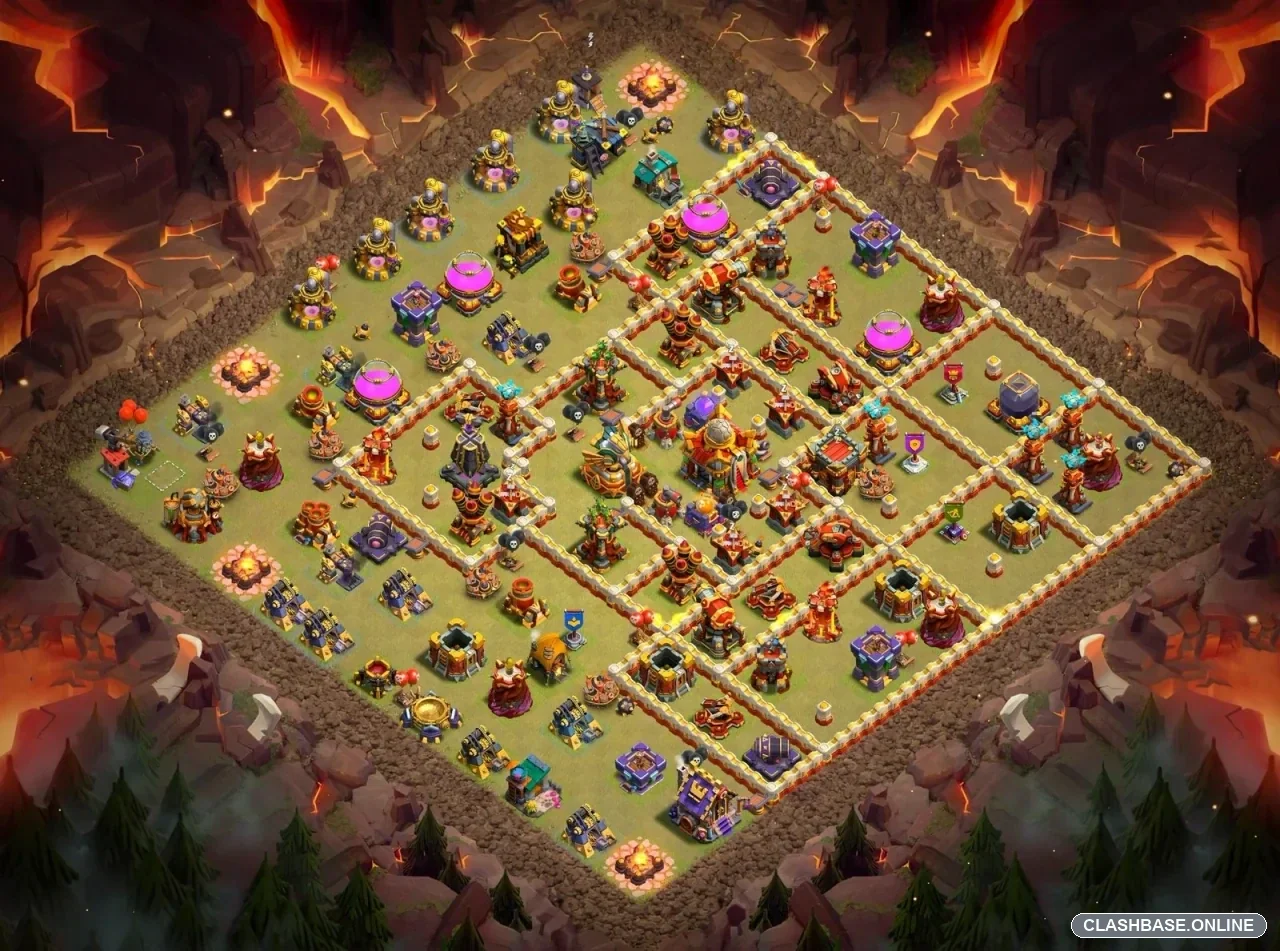
Town Hall 16 Ranked Layout #21 looks open enough to invite a confident attack, but the center is less forgiving than the first impression suggests. The Town Hall is positioned slightly to the left of the core, while the surrounding defenses are divided among several connected compartments. That arrangement creates a useful Ranked challenge: the attacker can build a route toward the main objective, but reaching it cleanly does not automatically solve the rest of the village.
The bottom edge is probably the first side I would inspect. There is enough room around five to seven o’clock to remove a few outside structures and create a reasonable funnel without committing the entire army immediately. That early percentage can make the entry feel comfortable. Still, the base becomes more complicated once troops cross the first wall and several neighboring compartments become available at the same time.
This is where a wide funnel could cause trouble.
Imagine a Root Rider or another heavy ground army entering from the bottom. The strongest units may move toward the central core, while the Queen or supporting troops begin clearing a nearby side section. For a short period, that can look like a successful attack. Two parts of the village are falling at once, percentage is rising, and the army still has plenty of health.
A little later, the split becomes more expensive. The main group reaches the Town Hall area while some of the heroes or support units are fighting several tiles away. A Rage, Heal, Freeze, Overgrowth, or another control spell that should support one concentrated push now has to cover only part of the army. That loss of efficiency may be enough to slow the attack without actually destroying it.
A narrow bottom-side funnel is likely to be much more dangerous to this layout. Root Riders or another heavy smash composition should be capable of crossing the walls, so the walls themselves are not the biggest concern. The real question is whether the attacker can keep tanks, heroes, healers, and support troops moving through the same lane.
If they can, the multi-compartment center becomes easier to manage. If they cannot, the base gains time.
Queen Charge Hybrid also looks like a realistic counter. A Queen beginning from the bottom could remove one defensive pocket and clear buildings that might otherwise pull Miners and Hog Riders toward the wrong section. That would give the main attack a more predictable route through the core.
The weakness of that plan is timing. A Queen who takes an unexpected path, spends too long on a high-hitpoint building, or continues along the outer edge can delay the Hybrid phase. The Town Hall may still fall, but the attack can finish with surviving buildings scattered across different compartments. In Ranked play, those extra seconds spent travelling are often just as important as defensive damage.
The Town Hall’s slight left-side offset also matters. A bottom entry may reach the core, but the objective is not sitting at the end of a perfectly straight lane. An attacker who focuses heavily on the Town Hall may leave the right side relatively healthy. Clearing more percentage before committing to the core can solve that issue, but it also keeps the Town Hall active for longer.
That tradeoff is what makes the layout feel genuinely suited to Ranked play.
Air attacks face a similar pathing problem in a different form. The Air Defenses appear spread across opposite sections, while the Inferno Towers support separate routes through the center. There is no single obvious area where one spell instantly removes every major threat.
Dragons could still find a usable route from the bottom after a proper funnel. A tighter deployment would probably be safer than spreading them across the entire edge. A wide line may send some Dragons toward outside buildings while the stronger group continues toward the Town Hall. Once the formation separates, the central push has less damage available exactly where the defensive pressure is highest.
LavaLoon offers more precise targeting, but it needs a planned sequence. Removing one Air Defense does not appear to open the whole village. The attacker still has to decide how to approach the Town Hall section, which Inferno threat should be handled next, and where the surviving Balloons are expected to finish.
What I find most interesting about Layout #21 is the way the base separates Town Hall access from comfortable cleanup. The bottom edge may provide an easy-looking start and useful early percentage, but the multi-compartment core can leave the army exiting in different directions. A player might secure the objective and still spend the final twenty seconds trying to reach buildings on the opposite side.
That is probably the layout’s most believable defensive strength. It does not need to stop the attack immediately. It only needs to make the route inefficient enough that the clock becomes part of the defense.
There is an obvious weakness, of course. A disciplined player who creates a narrow bottom funnel and keeps the main force together may be able to open the core faster than intended. Queen Charge Hybrid and controlled Root Rider attacks seem particularly well suited to testing that approach.