 CLASHBASE.ONLINERanked
About this Town Hall 16 base
Copy this base to Clash of Clans
Tap the button below. Clash of Clans will open so you can place this layout in an available base slot.
Copy base to the gameClash of Clans must be installed on this device.Rate this layout
Share a useful, honest experience. One review is stored per visitor for this item.
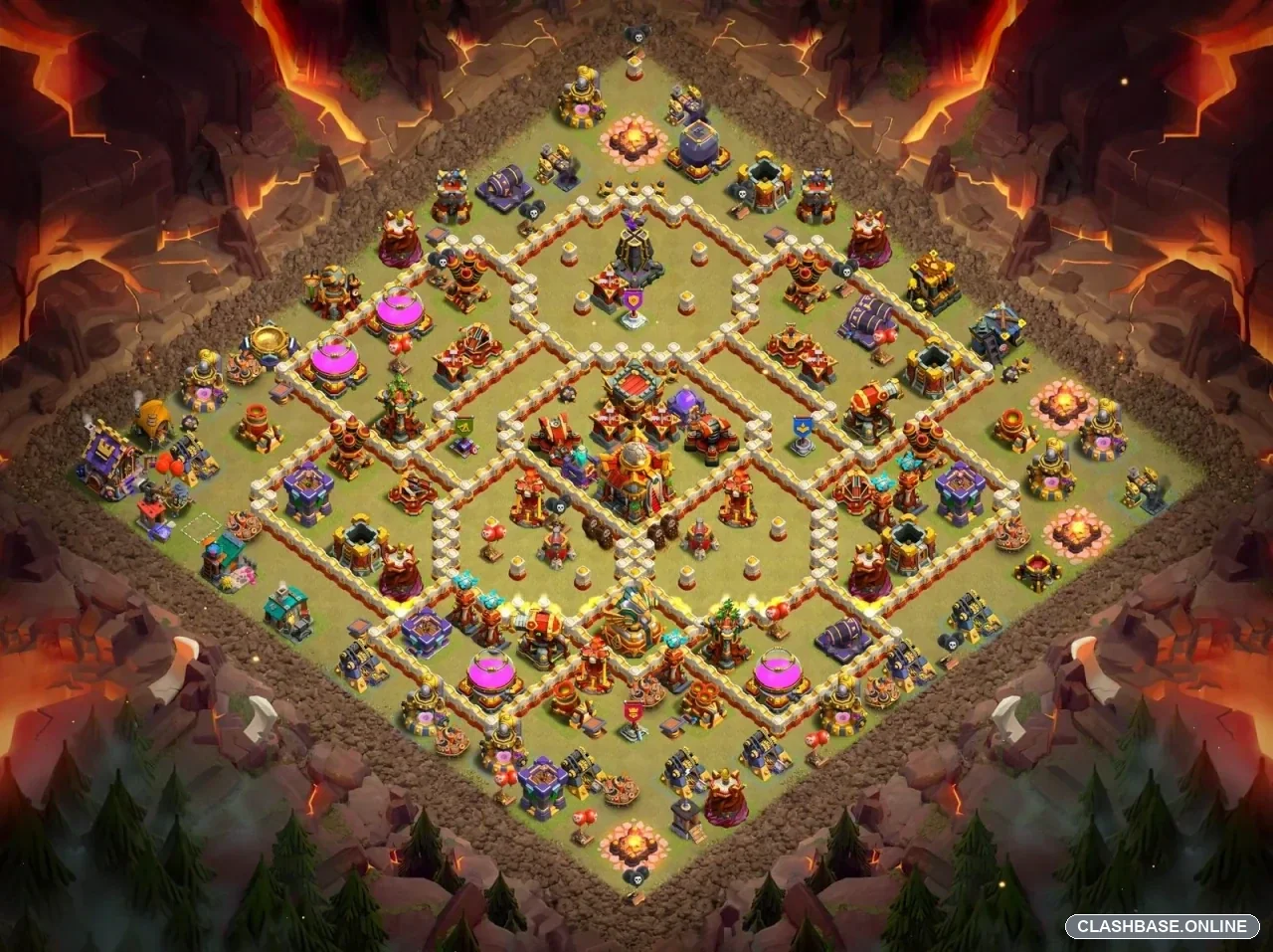
TH16 Ranked Base #31: Compact Core with High Spell Value and a Left-Side Entry
Town Hall 16 Ranked Layout #31 has a clean, almost geometric shape, but the attack is not as straightforward as the walls initially suggest. The Town Hall sits slightly to the right of the central line, surrounded by a compact square of important defenses. There are also several larger compartments around that core, which means an attacker has to make a choice fairly early: commit toward the Town Hall, or spend more time shaping the sides for safer percentage.
The left edge looks like the most practical place to begin. Around eight or nine o’clock, there is enough room to clear a few outside buildings without committing too many troops. From there, a controlled funnel could point the main army toward the center. I would avoid clearing the entire side, though. Once too many exterior targets disappear, troops may suddenly have access to several compartments, and what looked like a neat entry can become a fairly messy split.
That pathing risk matters with heavy ground armies.
Root Riders or another smash-style composition could probably break through the wall network without much trouble. The bigger question is whether the front line stays connected to the heroes and support troops behind it. If the army enters through one narrow lane, the attacker can keep Rage, Heal, Freeze, or other control spells focused on a single group. If the entry is too broad, one part of the army may drift toward an outer compartment while the stronger section continues toward the Town Hall.
For a few seconds, that split may actually look good. Two areas of the base are taking damage at once, and percentage rises quickly. The problem appears later, when the central group reaches the strongest defenses with less support than expected.
The core itself has an interesting weakness: several high-value defenses sit close enough together that one well-placed spell may affect more than one threat. That does not make the middle easy, but it gives a patient attacker a clear opportunity. If enough spells are preserved for the central phase, a Freeze, Overgrowth, Rage, or similar spell could create a short window where several defenses lose their impact at the same time.
That is why the opening is so important. An attacker who burns too many spells fixing a poor funnel may arrive at the core without the resources needed to exploit that central spell value. Someone who enters cleanly can save those spells for the section where they matter most.
Queen Charge Hybrid is another believable counter. A Queen beginning from the left could remove one defensive pocket and trim away buildings that might otherwise pull Miners and Hog Riders into the wrong lane. If she stays on the intended route, the Hybrid phase could enter the core through a much more controlled opening.
The catch is time. A Queen that walks outside, pauses on a storage, or takes a different wall path can delay the main phase quickly. Ranked attacks often punish that sort of delay because a strong percentage is not enough if the final buildings survive on opposite sides of the village.
The slightly right-side Town Hall placement also creates a subtle timing decision. A player coming from the left has to cross a meaningful part of the base before reaching the objective. Going directly toward it may secure the main target sooner, but some percentage can remain on the outer lanes. Clearing those lanes first creates a safer cleanup route, yet it keeps the Town Hall active longer.
That tradeoff is probably one of the reasons this layout makes sense for Ranked play.
Air armies have a different puzzle to solve. The Air Defenses and Inferno Towers are separated rather than stacked into one convenient cluster. That spacing means there is no obvious single spell zone that solves the entire air defense network.
Dragons could still work from the left after a careful funnel. A tighter deployment seems more sensible than spreading them across the full edge. If the line becomes too wide, some Dragons may follow outside buildings while the main group travels toward the core. Once that happens, the strongest defenses are fighting only part of the army instead of the whole push.
LavaLoon gives the attacker more control over individual defenses, but it also requires a clearer sequence. Removing the first Air Defense is only the beginning. The attacker still has to decide how to cross into the Town Hall section, which Inferno threat matters next, and where the surviving Balloons should finish.
What I find most interesting about Layout #31 is that its central strength and weakness are closely connected. The compact core creates concentrated defensive pressure, which can make the Town Hall section dangerous. At the same time, that concentration can give a skilled attacker unusually good spell value. The battle may therefore come down to whether the attacker reaches the middle with enough troops and enough spells still available.
The left edge is probably the first route experienced players will test. A disciplined funnel from that side can create a clean line into the base, while a careless one may send troops into two separate compartments. That difference could completely change the result even when the same army is used.