 CLASHBASE.ONLINEFarming
About this Town Hall 17 base
Copy this base to Clash of Clans
Tap the button below. Clash of Clans will open so you can place this layout in an available base slot.
Copy base to the gameClash of Clans must be installed on this device.Rate this layout
Share a useful, honest experience. One review is stored per visitor for this item.
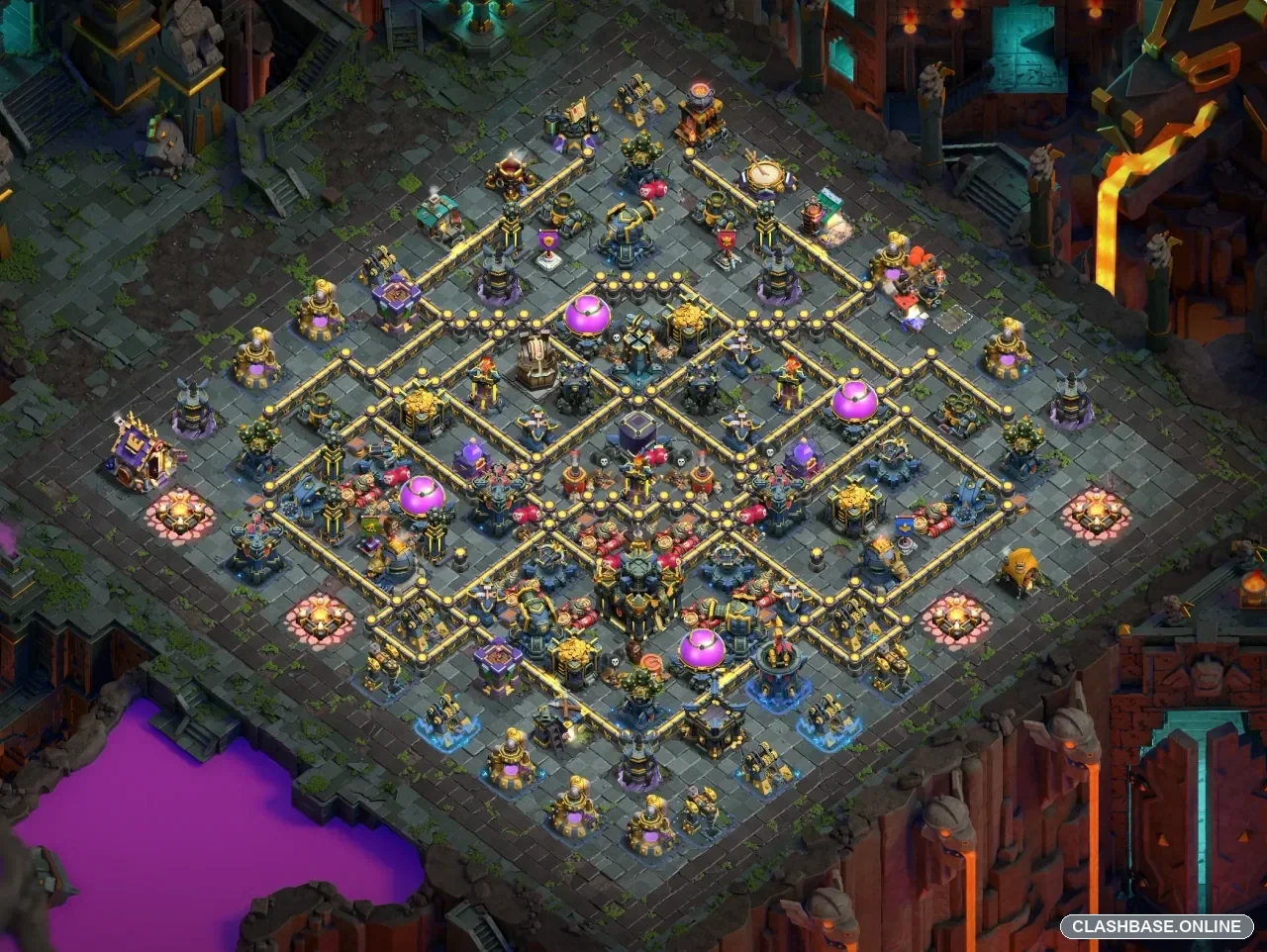
TH17 Farming Base #1: Multi-Compartment Core with a Bottom-Side Resource Route
Town Hall 17 Farming Layout #1 is built around a compact central area, but it does not place every valuable building inside one easy-to-read box. The Town Hall sits near the center behind the main storage line, while the surrounding walls divide the village into several smaller compartments. From a farming perspective, that structure makes sense. An attacker may break into one section and collect useful loot, but moving from that first pocket to the next one requires more time, more wall access, and usually a second decision about pathing.
The bottom edge, around six o’clock, looks like the most natural starting point. There is enough space there to remove a few exterior buildings and establish a funnel without committing the whole army immediately. It is also one of the shorter routes toward the central resource area. Still, I would not describe it as an automatic weakness. The success of that entry depends heavily on how narrow the attacker keeps the funnel.
A wide deployment could become messy quite quickly.
Imagine Root Riders or another heavy ground army entering from the bottom. The main tanks may move toward the Town Hall, while the Queen or supporting troops notice targets in a neighboring compartment and drift sideways. For the first part of the attack, that split may actually look productive. Multiple buildings are falling, percentage is climbing, and there is no obvious sign that the raid is losing control.
The problem appears later. When the main force reaches the stronger inner defenses, part of the support army may be several walls away. A Rage, Heal, Freeze, or another control spell that was supposed to cover one concentrated push suddenly helps only half of it. That can leave the central group weaker than expected and force the attacker to spend extra spells just to restore momentum.
A tighter bottom-side funnel would be far more dangerous to the base. Root Riders or another heavy smash composition should have enough strength to cross the first wall layers, so the defense cannot rely on the walls alone. What matters more is whether the compartments can encourage troops to change direction before they reach every important storage.
Queen Charge Hybrid looks like another realistic counter. A Queen starting near the bottom could remove one defensive pocket and clear away buildings that might otherwise pull Miners and Hog Riders into a side lane. If the Queen follows the intended route, the Hybrid phase could enter the core through a much cleaner channel.
That plan may sound simple, but it has one obvious risk: time. A Queen that spends too long on a storage, takes an awkward turn, or needs an additional wall opening can delay the main phase. The Town Hall may still fall, yet a storage on the opposite side could survive because cleanup starts too late. In a farming layout, that is still useful defensive value.
The Town Hall's central placement adds another interesting choice. An attacker coming from the bottom can focus directly on the objective, but the remaining storages do not all sit neatly behind it. Going straight for the Town Hall may leave loot in the left or right compartments. Chasing those storages first improves the resource haul, but it also makes the route through the middle slower.
That difference between objective access and complete resource access is one of the better aspects of the design.
The air setup also appears spread rather than concentrated. Air Defenses provide staggered coverage around the core, while the Inferno Towers act as separate high-value threats. That makes it harder for an air attacker to solve the entire village with one simple spell sequence.
Dragons could probably attack from the bottom after a careful funnel. A narrow deployment would likely keep more of them moving toward the center. A wide line, on the other hand, may cause several Dragons to follow exterior buildings while the stronger group pushes toward the Town Hall. Once the formation separates, the main group receives less support against the heaviest defenses.
LavaLoon gives the attacker more control over individual targets, but it still requires planning beyond the first Air Defense. Removing one threat does not appear to open every important compartment. The attacker has to consider where the Balloons will move next, how the Town Hall fits into the route, and which remaining storage pocket will become the back end.
The most believable weakness is time pressure created by a poor funnel. If the main army splits between adjacent compartments, a raid can reach strong percentage without actually collecting everything. Troops may finish in different parts of the village and spend the final seconds travelling instead of attacking. One surviving storage can make a meaningful difference in repeated farming defenses.
That is why Layout #1 works better as a farming design than as a simple trophy base. It is not trying to make the first valuable building impossible to reach. Instead, it makes each additional storage demand more commitment. The first section may be accessible. The next one requires another wall transition or a change of direction. By the time the attacker reaches the final pocket, the army may already be stretched and the clock may be becoming uncomfortable.