
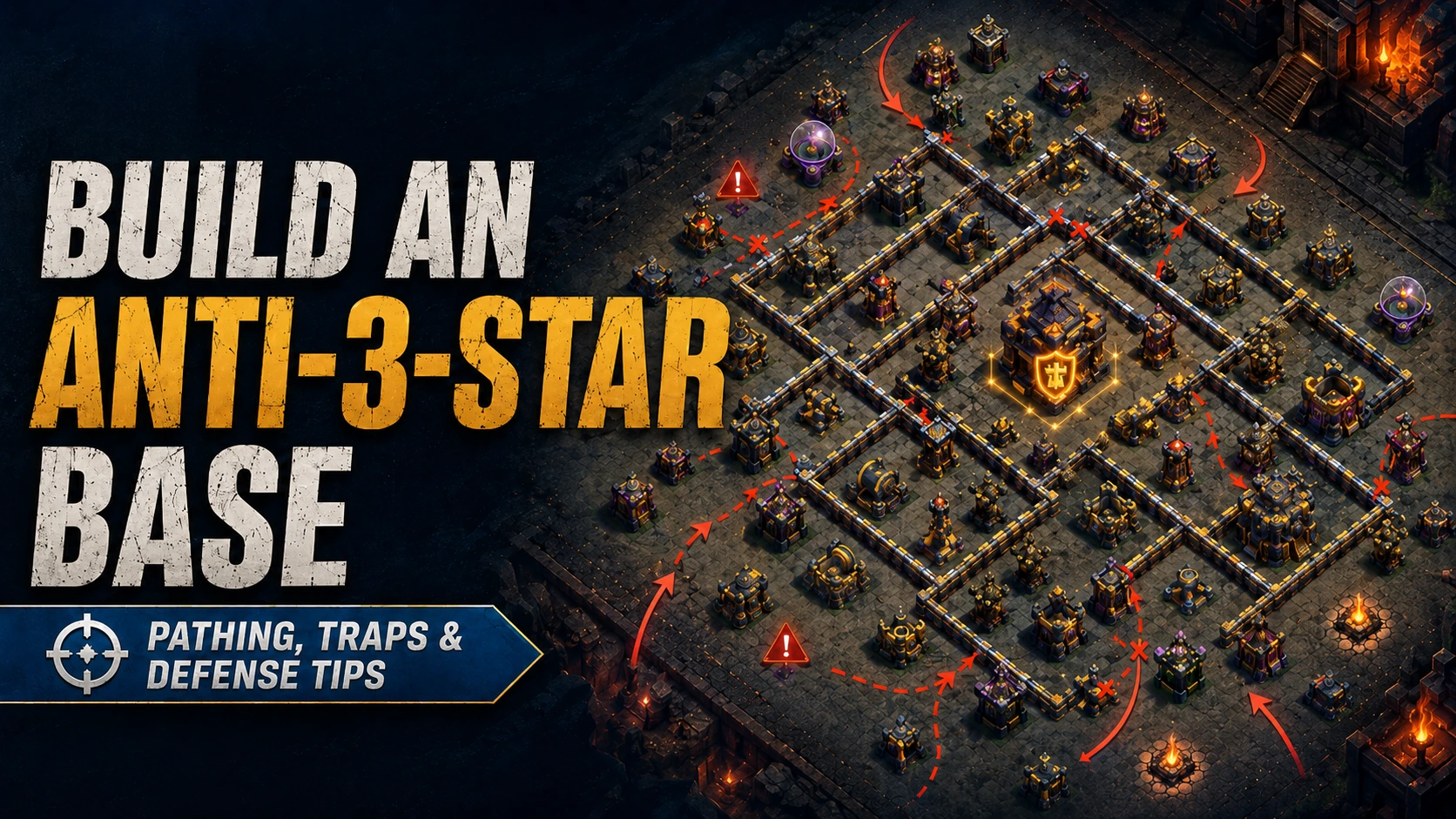
How to Build an Anti-3-Star Base in Clash of Clans
An anti-3-star base is not supposed to be impossible to beat. Against a skilled attacker with the right army, good timing, and a full preparation period, almost any layout can eventually be tripled.
The real goal is simpler: make the attack awkward.
A strong anti-3-star base forces the attacker to make several correct decisions in a row. One bad funnel, one misplaced spell, or one Hero walking in the wrong direction may be enough to turn a potential three-star attack into a messy two-star result.
And honestly, that is often a win. In Clan Wars, holding an attacker to two stars and 80% destruction may help your clan far more than using a compact-looking base that collapses as soon as the main army reaches the core.
Build Around the Attacks You Actually Face
Before moving Walls or defenses, look at your recent defensive replays.
Which armies keep appearing? Dragons? Root Riders? Queen Charges? Ground smash attacks? The answer will depend on your Town Hall level, league, and the players you usually face.
At Town Hall 18, for example, Dragon-based attacks and Thrower-Healer strategies have had a noticeable influence on the war meta. That may suggest that a base designed only to stop one ground army will struggle against coordinated air attacks.
Trying to counter every possible strategy equally usually produces a layout that is average against everything. A better approach is to identify two or three common armies and deliberately build areas that punish them.
Do Not Make the Town Hall Too Easy to Read
Many players automatically place the Town Hall in the exact center. That can work, but it also makes the attacker’s objective fairly obvious.
An offset Town Hall creates a more uncomfortable decision. The attacker might enter from that side to secure the star early, but doing so could leave several major defenses untouched. Coming from the opposite direction may offer better defensive value, yet it also creates the risk of missing the Town Hall.
Avoid stacking everything important around it. When the Town Hall, Clan Castle, Heroes, storages, and strongest defenses sit inside one small compartment, a single army push can remove half the base.
At higher Town Hall levels, special defensive mechanics also affect the Town Hall area. Those defenses should feel connected to the base design rather than added afterward wherever space remains.
Create Pathing That Is Hard to Predict
Good pathing can be more valuable than simply placing high-damage defenses together.
Symmetrical bases look neat, but they are often easy to understand. The attacker can identify the funnel, choose the entry, and predict where the main army will move.
Uneven compartments, offset openings, and carefully placed outside buildings may create more doubt. You want troops to hesitate, split, or drift away from the intended route.
For example, tanks might enter one compartment while the main damage dealers walk around the outside. A Hero may turn toward a storage instead of entering the core. These small mistakes can quickly ruin an otherwise well-planned attack.
Try not to leave one obvious path from the edge of the village directly to the Town Hall.
Spread Out Your Most Valuable Defenses
Packing strong defenses together may look intimidating, but it often gives the attacker excellent spell value.
One Freeze, Overgrowth effect, or Hero ability could disable several important defenses at once. Spreading those threats forces the attacker to choose which area deserves attention.
Air Defenses should not all be reachable from the same side. Splash defenses should cover different sections of the village. Long-range defenses can support the core, but they should not stand shoulder to shoulder with every other high-value target.
The idea is not to scatter everything randomly. You still want overlapping defensive coverage—just without creating one perfect spell target.
Place Traps With a Reason
Random trap placement sometimes works, mostly because attackers cannot predict everything. Still, replay-based trap placement is usually more reliable.
Watch where Queen Charges tend to begin. Notice where Healers travel, where ground troops bunch up, and which side attackers regularly use for their funnel.
Seeking Air Mines can punish Healers or key flying troops. Giant Bombs are more useful in areas where ground armies naturally group together. Disruption traps are especially valuable near sections where a few lost seconds could change the entire attack.
Do not automatically place every trap around the Town Hall. Experienced attackers usually expect that. A trap near a common entry point may catch far more players.
Test the Base Before Rebuilding It
No anti-3-star layout stays effective forever. New troops, balance changes, Hero equipment, and popular attack strategies can all change what works.
Use Friendly Challenges and ask clanmates to attack with different armies. Watch the pathing closely. Did the Heroes enter where you expected? Were important defenses removed too easily? Did the traps activate at the right moment?
One triple does not always mean the whole base is bad. Sometimes the attacker simply played well. A small Wall change, a trap adjustment, or moving one defense may be enough.
The best anti-3-star bases are rarely unbeatable. They are confusing, uncomfortable, and unforgiving—and that is usually enough.