 CLASHBASE.ONLINEFarming
About this Town Hall 16 base
Copy this base to Clash of Clans
Tap the button below. Clash of Clans will open so you can place this layout in an available base slot.
Copy base to the gameClash of Clans must be installed on this device.Rate this layout
Share a useful, honest experience. One review is stored per visitor for this item.
TH16 Farming Base #10: Broken-Ring Resource Defense with an Upper-Right Funnel
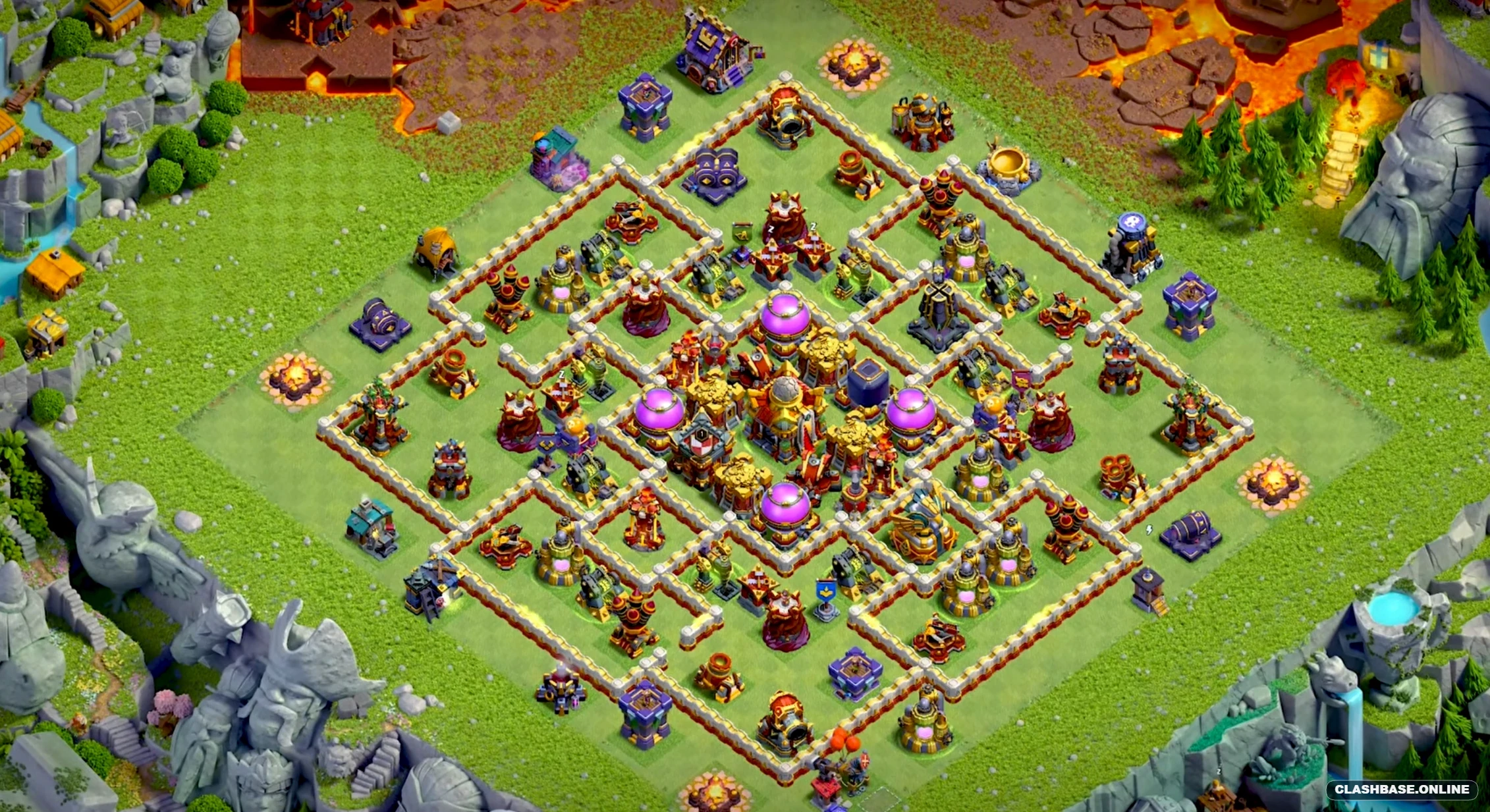
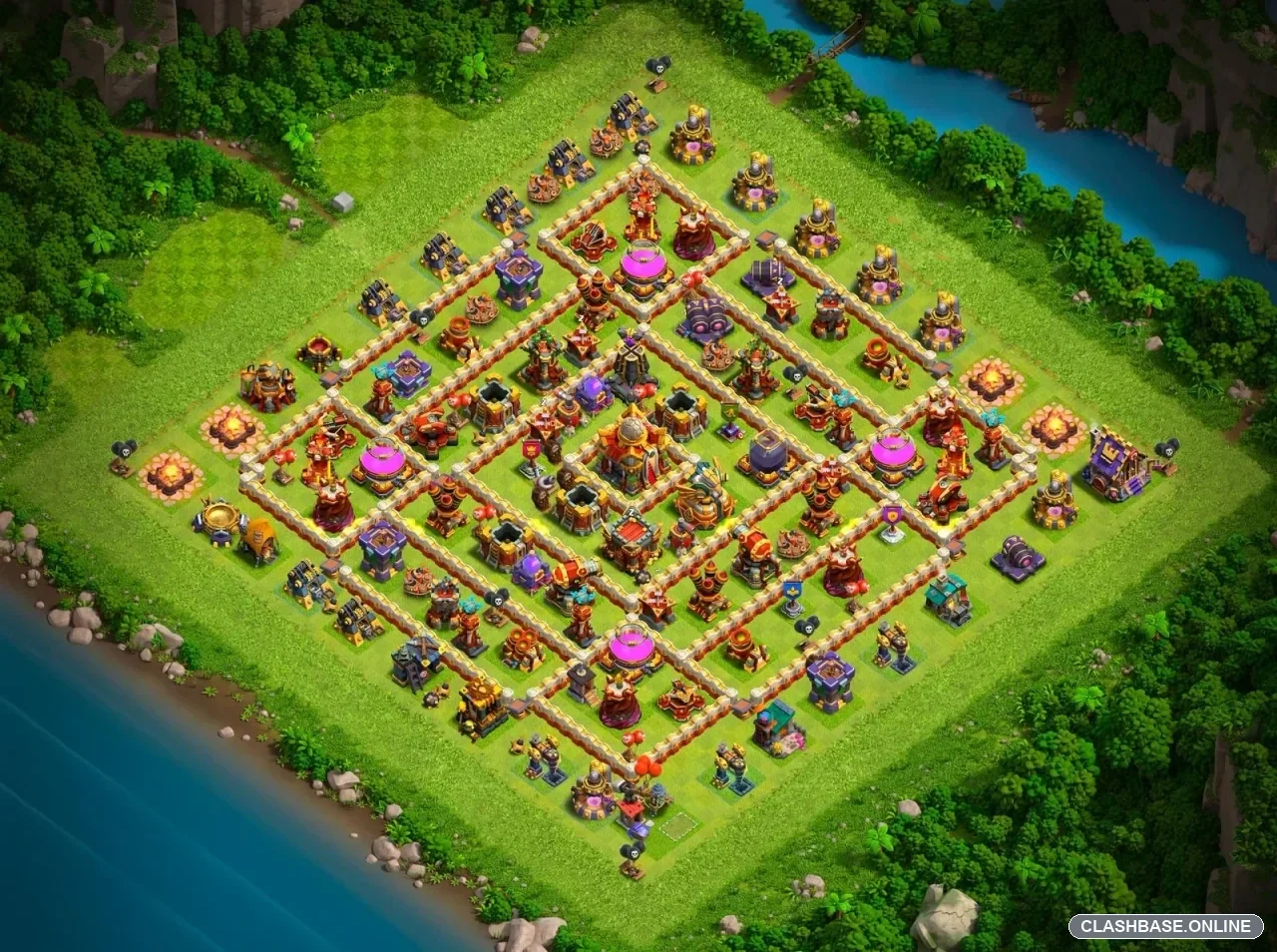
Town Hall 16 Farming Layout #10 uses a compact inner defense surrounded by a broken-ring wall structure, and that shape is what gives the base most of its character. The Town Hall sits near the center behind the main storage line, while the important resource buildings are separated across several compartments instead of being stacked together in one easy-to-reach pocket.
That separation matters more than it may seem.
A farming attacker can probably reach one useful section without committing the entire army. Getting from that first storage to the Town Hall, then across to the remaining Gold, Elixir, or Dark Elixir value, is a different problem. The walls repeatedly ask troops to change direction, and a raid that begins cleanly may become less organized once the central compartments start opening.
For a farming base, that is a sensible goal. The layout does not need to pretend that every storage can survive against a properly planned TH16 army. It simply needs to make collecting everything noticeably harder than collecting something.
The broken-ring core is the main defensive idea
The center does not behave like one traditional square compartment. Instead, the walls partially wrap around the Town Hall and nearby storages, with openings that connect different sections of the village.
That can create awkward troop movement.
Imagine a ground army entering through one corner. The main tanks start moving toward the center, but the Queen notices a nearby defense and continues through an outside compartment. Support troops may follow another line entirely.
For the first part of the raid, nothing necessarily looks wrong. In fact, the attack can appear unusually strong because several sections are falling at once.
The problem shows up later.
When the main group finally reaches the Town Hall area, some of its support may be several walls away. Rage, Heal, Freeze, Overgrowth, or another control spell that should strengthen one concentrated push now helps only part of the army.
That reduction in spell efficiency may be where this base earns much of its defensive value.
Why the upper-right edge looks like the natural entry
The upper-right side, around one or two o’clock, appears to offer the most comfortable funnel.
There are enough exterior structures to remove without immediately committing the full army, and that angle provides a fairly natural route toward the central compartments. A Queen Charge could begin there, or a small group of funnel troops could shape the edge before a larger ground force enters.
The temptation would be to clear too much.
A very wide funnel can expose several compartments simultaneously. Root Riders may continue toward the Town Hall while the Queen follows targets farther around the outside. Dragons can experience the same issue, with one group moving into the core and another chasing buildings along the perimeter.
For twenty or thirty seconds, that split can look productive. Percentage rises quickly and multiple defenses disappear.
Then the attack needs concentrated damage, and the troops are no longer concentrated.
That is why I would consider a tight upper-right entry more dangerous to this layout than simply spreading a full army across the side.
The main weakness is cutting the ring before troops circle
The most visible weakness in TH16 Farming Layout #10 is an attacker who interrupts the broken ring early.
If the correct upper-right buildings are removed and the main army is directed through one controlled lane, much of the layout's pathing uncertainty disappears. Troops are less likely to circle around the central objective and more likely to move directly toward it.
Queen Charge Hybrid looks especially useful for creating that kind of entry.
A Queen could start from the upper-right, remove one defensive compartment, and clear the targets most likely to pull Miners and Hog Riders sideways. Once that route is established, the Hybrid portion should have a much more predictable line into the middle.
Still, Queen Charge introduces another problem for the attacker: time.
A Queen that walks around one extra compartment can easily lose several seconds. A high-hitpoint building or slow wall break adds more. The Town Hall may still fall, but the final storage could be sitting on the opposite side of the base while the surviving troops are already racing the clock.
That is a perfectly useful farming-defense outcome. The attacker does not have to lose every troop for the layout to save some resources.
Root Riders can push through, but pathing still matters
Root Riders or another heavy ground smash army would also be an obvious way to challenge the design.
They are comfortable dealing with walls, so the broken ring itself is not enough to stop them. What matters is whether the base can separate the front line from the heroes and support behind it.
A compact smash could be dangerous.
If Root Riders, heroes, healers, and supporting troops all enter the same lane, the attacker can concentrate spell value around the Town Hall and nearby defenses. A Heal or Rage affects the main group, while Freeze or Overgrowth controls the most dangerous defensive section.
Spread that same army across two compartments and the attack becomes much less efficient.
That is an important distinction. The layout is not really asking, “Can you break these walls?” A strong attacker probably can.
It is asking, “Can you break them without losing the shape of your army?”
Air attacks have multiple threats to manage
The Air Defenses appear positioned to cover crossing lanes instead of protecting only one side. The Inferno Towers are also separated enough that they function as individual high-value targets rather than one convenient pair.
That makes the air route less obvious.
Dragons could still attack through the upper-right after the funnel is prepared. Personally, I would expect a relatively narrow deployment to be safer. When Dragons are spread across too much of the edge, several may remain on outside buildings while the stronger group enters the central section.
Once that happens, the core receives less concentrated damage than the attacker originally planned.
LavaLoon gives more control over individual targets, but it also requires a clear second phase. Destroying one Air Defense does not automatically solve the village.
The Balloons still need a useful route through the broken-ring center, enough support for the Town Hall section, and a sensible finish near the remaining resource buildings.
The opening may look easy enough. The transition is where the attack is more likely to become awkward.
Why this layout works as a farming base
The strongest farming feature in Layout #10 is the spread-out resource value.
The Town Hall is central, but the storages do not all sit on exactly the same attack line. An attacker may take one storage quickly. Another requires a wall transition. A third may sit across the core, forcing surviving troops to turn or travel.
That travel time can become part of the defense.
A farming raid sometimes ends with plenty of troops still alive, yet one storage survives because those troops finish twenty tiles away from it. The final seconds disappear while the army walks instead of attacks.
This layout appears designed to encourage exactly that kind of result.
There is an identifiable weakness, of course. A disciplined attacker who recognizes the upper-right route, breaks the ring early, and keeps the main force compact could open the center considerably faster than intended. Queen Charge Hybrid, Root Riders, Dragons, and LavaLoon all look like realistic counters depending on the player's execution.
That does not make the base ineffective.