 CLASHBASE.ONLINEFarming
About this Town Hall 16 base
Copy this base to Clash of Clans
Tap the button below. Clash of Clans will open so you can place this layout in an available base slot.
Copy base to the gameClash of Clans must be installed on this device.Rate this layout
Share a useful, honest experience. One review is stored per visitor for this item.
TH16 Farming Base #19: Split Storage Routes with a Broken-Ring Core
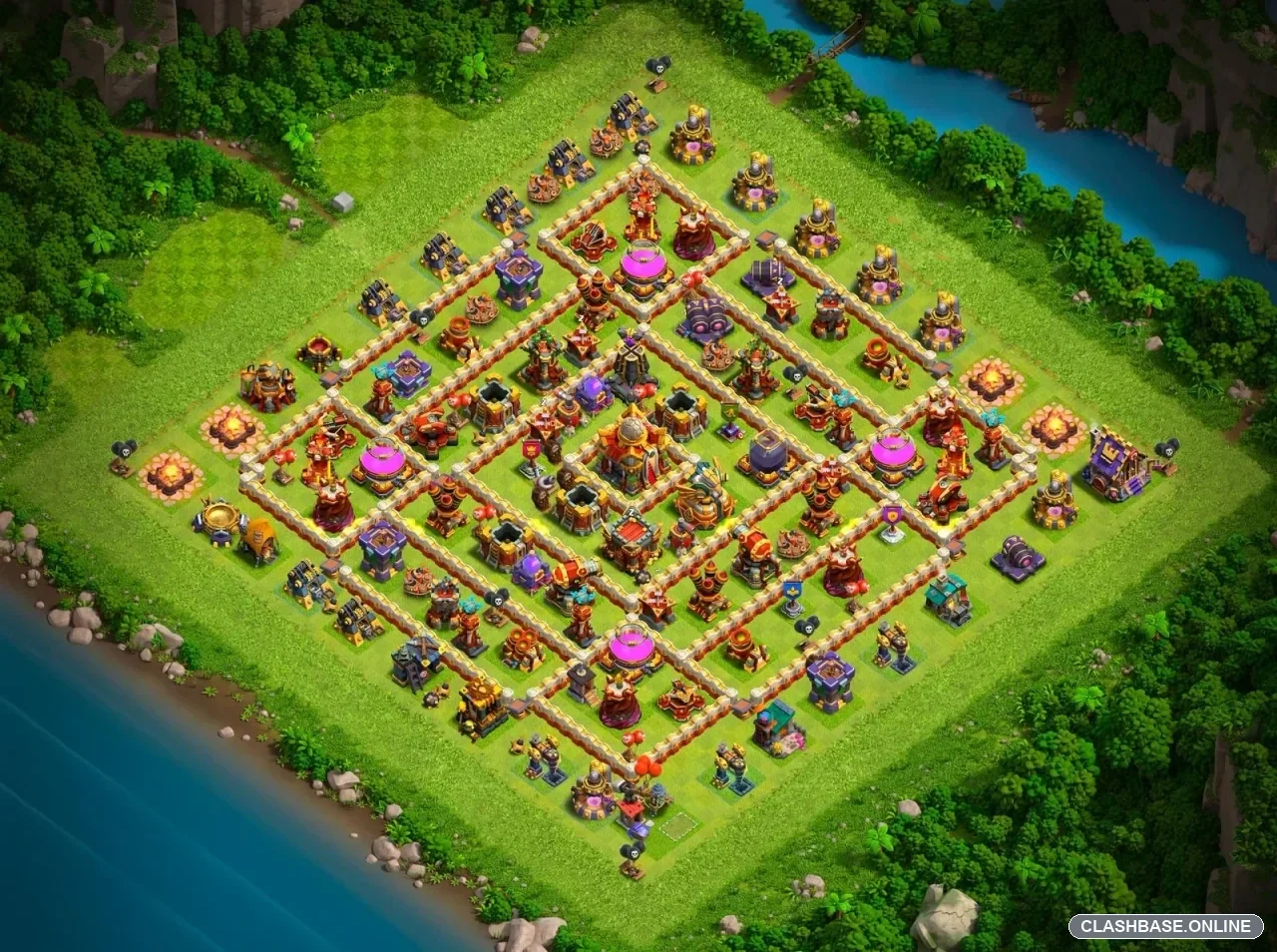
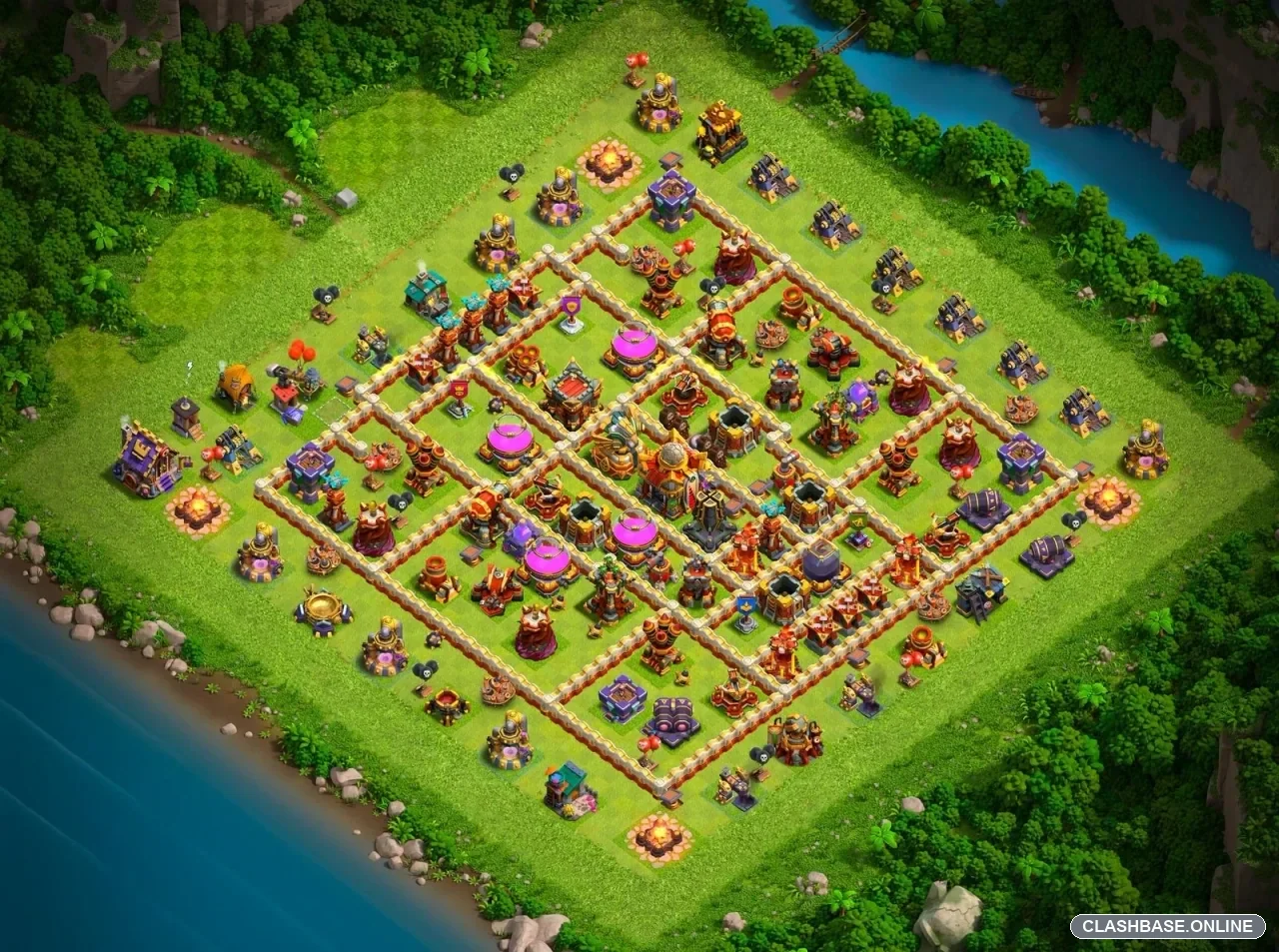
Town Hall 16 Farming Layout #19 takes a more compartment-driven approach to protecting loot. The Town Hall sits slightly below the visual center, while the important resource buildings are spread through several sections instead of being stacked into one obvious storage block. The walls form a broken-ring pattern around the middle, which means an attacker can break into the village without necessarily opening a comfortable path toward every valuable target.
That distinction is important for a farming base. The goal is not always to stop a strong TH16 army from taking anything. Realistically, a prepared attacker can usually secure some loot. A more useful defensive idea is to make the second, third, and final storage progressively more expensive to reach.
Layout #19 appears to follow that philosophy.
Why the broken-ring center matters
The central wall structure does not create one clean square around the Town Hall. Instead, compartments connect at different angles, with enough interruptions in the ring to influence where troops travel after their first target falls.
That can produce slightly awkward pathing.
A ground army may enter successfully and destroy the first compartment, only for one part of the force to continue toward the Town Hall while another group turns toward a nearby defense. For a few seconds, this actually looks helpful to the attacker. Two parts of the base are being cleared simultaneously.
Then the attack reaches the center.
If the Queen, heroes, or support troops are no longer beside the main tanks, spells become harder to use efficiently. A Rage, Heal, Freeze, Overgrowth, or another support spell might protect one section while leaving the other group exposed.
That does not guarantee the defense succeeds, of course. What it does is introduce another decision at a point where the attacker would prefer one simple route.
The upper-right edge is the first place I would test
From the screenshot, the upper-right side—around one or two o’clock—looks like the cleanest place to establish a funnel.
There are exterior buildings that can be removed without spending too much housing space, and the angle into the inner base appears relatively natural. A Queen Charge, a few funnel troops, or the edge of a ground smash could be used to create a controlled entry.
The mistake would be opening too much of that side.
A very wide funnel can expose several compartments at once. Root Riders may start pushing toward the center while heroes continue along the outside. Dragons can do something similar, with one group travelling inward and another following structures around the perimeter.
That is why I would consider a tight upper-right funnel more dangerous to this layout than simple spam.
Interrupting the ring early is the main weakness
The clearest weakness is an attack that deliberately breaks the ring before troops begin travelling around it.
If the attacker removes the correct upper-right structures and forces the army inward, much of the layout's pathing advantage disappears. The Town Hall and inner defensive section become more predictable targets.
Root Riders or another heavy ground smash army could benefit from that opening. These troops are less dependent on conventional wall access, so once the funnel is established, they can cross several compartments without losing as much time.
The challenge is keeping the army together.
If Root Riders, heroes, healers, and support troops stay in one group, spell value improves significantly. If the formation spreads, the broken-ring structure starts doing what it was designed to do.
Queen Charge Hybrid could give the attacker more control
Queen Charge Hybrid is another approach that makes sense here.
A Queen beginning from the upper-right could remove one defensive pocket first, clear the buildings most likely to pull troops around the edge, and shape a narrower route for Miners and Hog Riders.
If she enters the correct compartment, the Hybrid phase could travel through the center with much more predictable pathing.
There is a tradeoff, though.
Queen Charges cost time. One unexpected walk around the outside can add ten or fifteen seconds. A high-hitpoint building or a slow wall opening can delay the main push as well.
The attacker may still secure the Town Hall and good percentage, but one distant storage could remain untouched because cleanup started too late.
For a farming layout, that is meaningful defensive value.
Air attacks do not get one obvious solution
The Air Defenses are split around different inner compartments rather than grouped neatly together. Inferno Towers are separated as well, reducing the chance that one spell controls every major threat during the same moment.
Dragons could certainly be used from the upper-right after establishing a funnel. I would probably favor a narrower deployment. If too many Dragons remain on exterior buildings, the main group can reach the core without enough damage behind it.
LavaLoon offers more precise targeting, but the raid would need to be planned in stages.
Destroying the first Air Defense is only step one. The attacker still has to decide how to cross the broken ring, which central threat deserves the next spell, and where the surviving Balloons should finish.
That final route matters because the storages are not all sitting together.
Why the Farming label fits this layout
The clearest farming feature is the distance between resource pockets.
An attacker might take one storage comfortably. The next one can require another wall transition. A third may sit across the center, forcing surviving troops to change direction yet again.
That travel time adds up.
A farming defense does not always succeed because every attacking troop dies. Sometimes the army survives but finishes in the wrong place. The attacker watches thirty seconds disappear while troops move from one side of the village to another, and one valuable storage remains standing.
That appears to be the defensive idea behind Layout #19.
The base is certainly beatable. A disciplined upper-right entry that interrupts the broken ring early could make the center considerably easier to navigate. Queen Charge Hybrid, Root Riders, Dragons, and LavaLoon all look like realistic counters depending on execution.
Still, the layout has a useful farming identity because quick loot and complete loot are not the same route.