 CLASHBASE.ONLINEClan War
About this Town Hall 16 base
Copy this base to Clash of Clans
Tap the button below. Clash of Clans will open so you can place this layout in an available base slot.
Copy base to the gameClash of Clans must be installed on this device.Rate this layout
Share a useful, honest experience. One review is stored per visitor for this item.
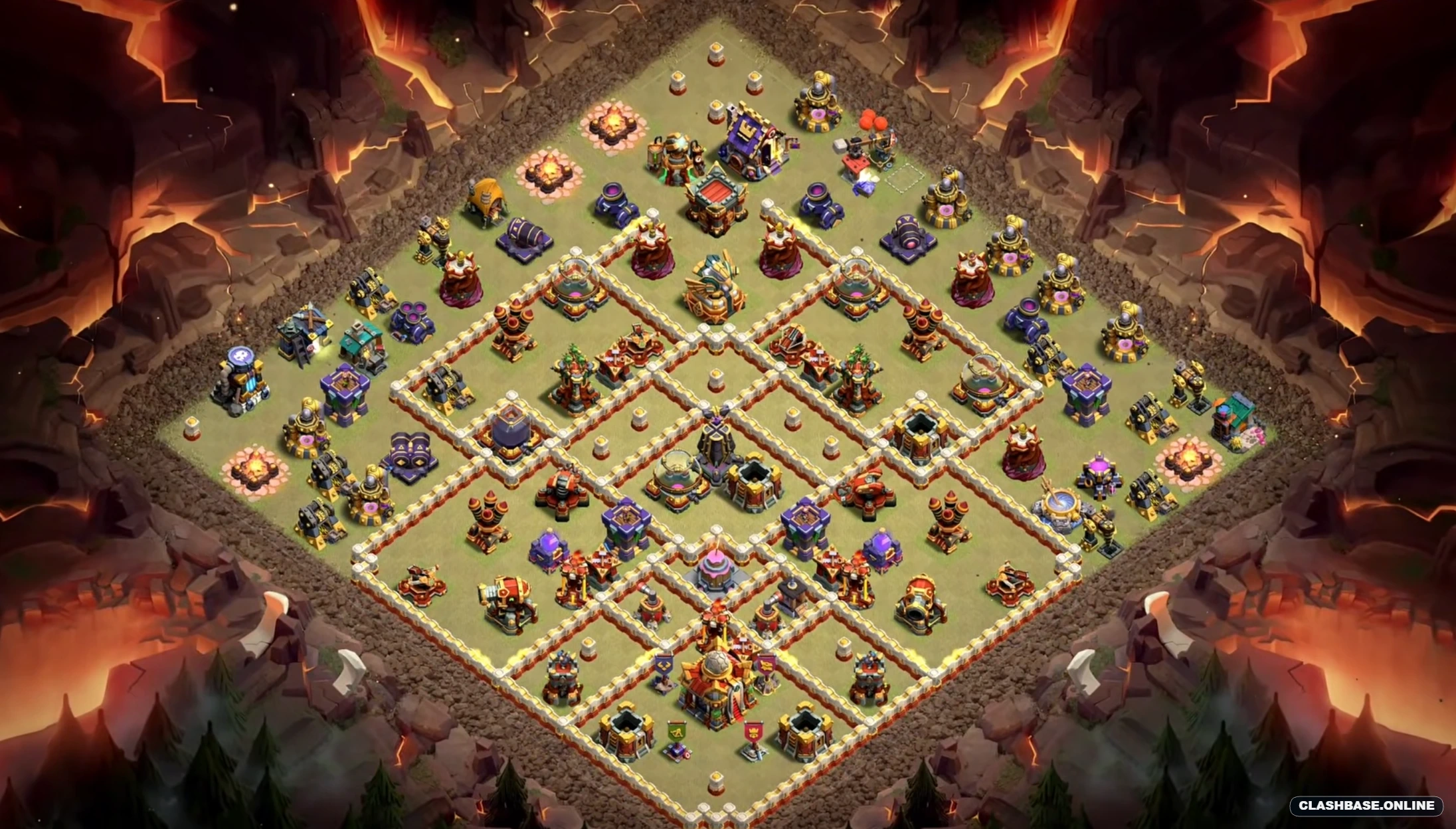
TH16 Clan War Base #14: Asymmetric Diamond with a Short Right-Side Route
Town Hall 16 Clan War Layout #14 is built around an uneven diamond shape rather than a perfectly mirrored war design. That asymmetry is the first thing that makes the base interesting. The Town Hall sits close to the edge of the inner core, while the surrounding defenses are spread across compartments of different sizes and depths. From the scouting screen, there is no single route that obviously collects the Town Hall, the strongest defenses, and the back-end percentage in one smooth push.
The right edge, around three or four o’clock, looks like the most practical place to begin. There is enough room to trim a few outside structures and create a controlled funnel without committing a large part of the army immediately. More importantly, that side appears to connect with the shorter diagonal through the village. On paper, it is probably the most efficient route inward.
That shorter route is also where the base looks most vulnerable.
A carefully prepared ground attack could remove the right-side corner and reach several important defenses before the deeper side of the layout has much influence on the fight. Root Riders or another heavy smash composition would make sense here because they can cross wall sections without spending too much time creating individual openings. If the attacker keeps the entry narrow, the army may move through the diagonal with heroes and support troops still close together.
The difference between a narrow and wide funnel could be huge.
Imagine Root Riders moving toward the inner core while the Queen continues following buildings along the outside-right lane. For twenty seconds, the attack might look excellent. Two areas are being cleared at once, percentage is climbing, and nothing appears to be going wrong. Then the front line reaches the Town Hall section while part of the supporting force is still several tiles away.
At that point, spell efficiency drops. A Rage, Heal, Freeze, Overgrowth, or similar spell that should support one strong push now covers only part of the army. What looked like extra early value becomes a pathing problem, and that is exactly the sort of mistake an asymmetric war base can punish.
The Town Hall position adds another tactical choice. Because it sits near the edge of the inner core, the attacker may have an opportunity to secure it earlier than on a deeply centered design. In Clan War, that is tempting. A player can protect the two-star result and then worry about the remaining percentage.
The problem is what gets spent to guarantee that objective.
If too many hero abilities, spells, or core troops are committed around the Town Hall, the far side can remain surprisingly healthy. A safe attack may finish with strong percentage but still fall short of three stars. A more ambitious player can preserve resources for the back end, although that means accepting more risk during the Town Hall phase.
That separation between objective security and full-base cleanup is probably the strongest reason this layout works as a Clan War design.
Queen Charge Hybrid is another believable answer. A Queen starting from the right could clear one defensive pocket first, remove buildings that might disturb the funnel, and leave Miners and Hog Riders with a more predictable route through the shorter diagonal. If everything goes according to plan, this may be one of the cleaner ways to attack the base.
Still, Queen pathing is never completely predictable. One outside structure can keep her walking around the perimeter instead of turning inward. A slow wall break can cost valuable seconds. The attack may still take the Town Hall, but the delayed Hybrid phase can make the opposite compartments much harder to finish.
Air armies face a different type of problem. The Air Defenses are staggered around separate sections rather than being concentrated into one obvious cluster. The Inferno Towers also behave as individual high-value targets. That means an air attacker cannot simply neutralize one part of the base and assume the rest of the route is solved.
Dragons could potentially enter from the right after a good funnel. I would expect a tighter deployment to be more reliable than spreading them across the entire edge. If several Dragons follow outside targets while the stronger group turns toward the core, the Town Hall section receives only part of the intended attack.
LavaLoon offers more control over target order, but the second phase becomes important. Taking down the first Air Defense does not appear to open the whole village immediately. The attacker still has to decide how to transition through the core, which Inferno threat matters next, and where the surviving Balloons are expected to finish.
The main weakness remains the shorter diagonal. Supporting defenses have less room to overlap there, so a precise attacker may remove several valuable targets before the opposite sections can contribute their full defensive pressure. That is a genuine vulnerability, not just a visual one.
However, exploiting it properly requires discipline. A rushed right-side spam attack could do exactly what the base wants: split the army, weaken spell coverage, and leave troops exiting the Town Hall area in different directions.
That is where Layout #14 earns its anti-three-star character. It is not built around one impossible compartment or one surprise trap. Its defensive value comes from making the attacker plan beyond the Town Hall. The objective may fall, but the raid still has to transition through several awkward compartments afterward.