 CLASHBASE.ONLINERanked
About this Town Hall 13 base
Copy this base to Clash of Clans
Tap the button below. Clash of Clans will open so you can place this layout in an available base slot.
Copy base to the gameClash of Clans must be installed on this device.Rate this layout
Share a useful, honest experience. One review is stored per visitor for this item.
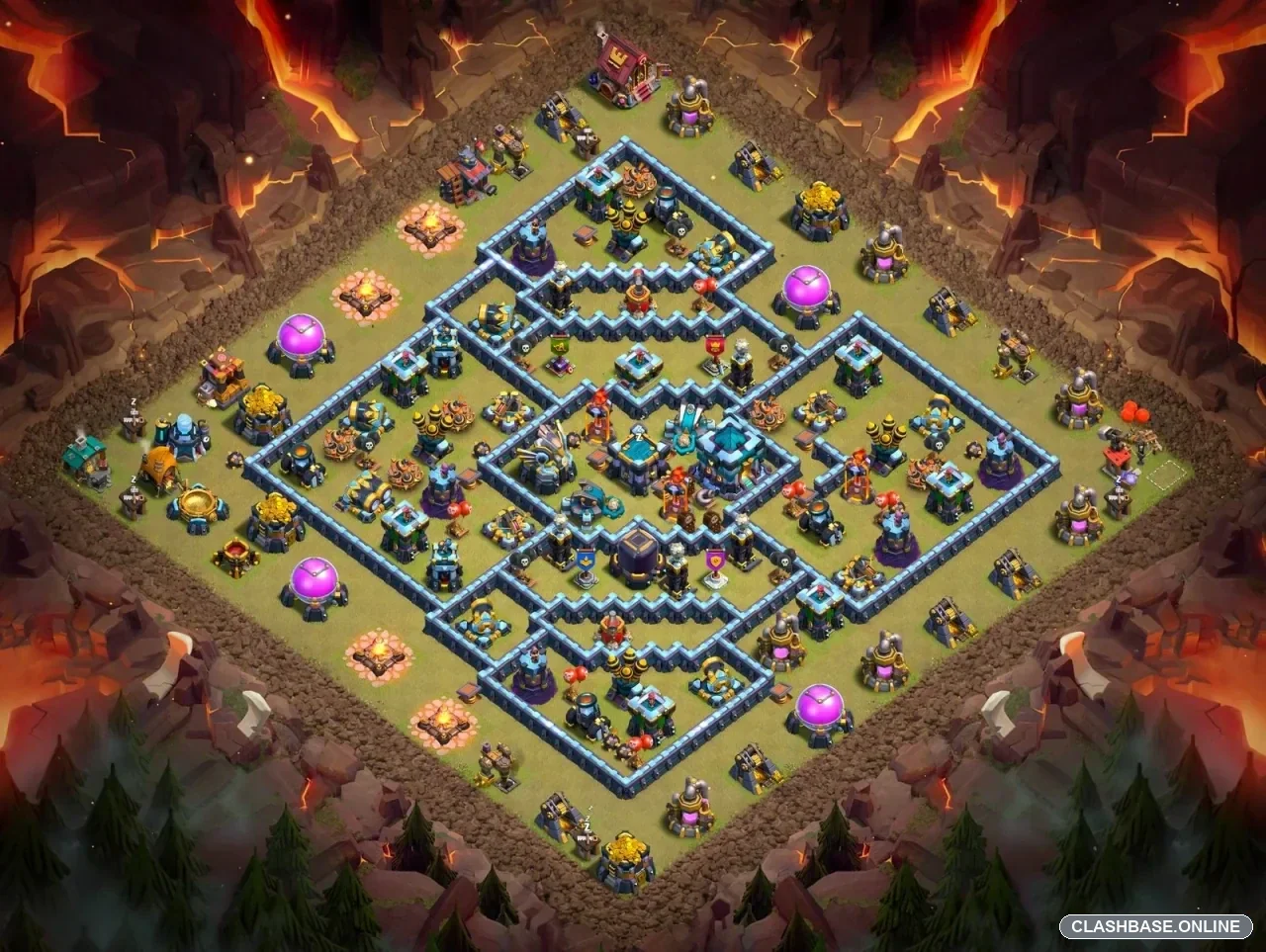
TH13 Ranked Base #25: Open-Ring Defense Built Around Pathing and Percentage Pressure
TH13 Ranked Layout #25 uses an open-ring structure with the Town Hall mildly offset toward the right side of the core. Looking at the actual layout, the defensive idea seems to be less about creating one brutal central box and more about making troops lose efficiency as they move between the large outer compartments and the denser middle.
That fits Ranked defense well. Some outside buildings may fall without much resistance, but the layout appears designed to make percentage increasingly expensive once the attacking force starts moving toward the Town Hall.
The Town Hall sits inside the real defensive pressure zone
The Town Hall is protected within the denser right-central portion of the base rather than sitting alone near an edge.
Several nearby defenses support that area, but the layout avoids stacking every high-value target in exactly the same compartment. This matters because the defense can lose one section and still keep meaningful firepower active elsewhere.
The slight Town Hall offset also makes the core less predictable. Troops approaching from one side may not naturally continue through the center in a straight line, which gives the surrounding compartments a chance to pull parts of the formation away.
The open ring is mainly a pathing weapon
The wall pattern is probably the most important defensive feature of Layout #25.
Large compartments surround the core, creating several routes that look equally attractive to troops. Once the first section opens, one group may begin moving around the ring while another turns toward the Town Hall.
From the defender's perspective, that split is valuable.
A concentrated Yeti or Bowler Smash is difficult to stop when tanks, heroes, and support troops stay together. Once that formation stretches across separate compartments, Infernos and other defenses get longer firing windows while spell support becomes less efficient.
The same principle can frustrate Queen Charge Hybrid: the defense wants the main force and cleanup elements working at different speeds.
Air pressure is spread rather than concentrated
The Air Defenses cover different approach lanes, while the Inferno Towers function more like separate inner anchors than one compact pair.
That spacing helps avoid one obvious defensive collapse point.
Against Dragons or LavaLoon, one part of the anti-air network can weaken while another remains active deeper inside. The layout therefore tries to make air armies survive several pressure zones rather than one single engagement.
This distributed coverage also makes spell timing less straightforward, which is useful for a Ranked base where every extra percentage point matters.
The upper-right side carries the most defensive risk
The upper-right edge appears to be the easiest part of the structure to shape, making it the main pressure point for the defense.
The real danger is not simply losing that edge. It is losing control of the ring.
If troop movement becomes too predictable from this side, the attacker may deliberately keep one group moving around the perimeter while another enters the core. That would turn the layout's biggest defensive strength—split pathing—into a weakness.
For that reason, this side benefits most from trap pressure, overlapping fire, and anything that makes the opening less controlled.